Donie
Dark Lies the IslandDonie is a man whose dependable rituals make an ordinary working day feel both ordered and necessary. For two decades he has ridden the train from Boyle to Sligo, and he watches over duck families by the Garavogue River; a stranger’s sudden assault breaks into this patterned life, leaving him unable to move through familiar streets and journeys as before.
Identity and Daily Order
Donie’s day begins with a precisely timed crossing of the metal traverse bridge at Boyle station. At 9:25 a.m. he counts all twenty-three steps up and down, taking the last clanky metal step onto the far platform just as the Dublin–Sligo train approaches. He finds satisfaction in getting the timing right, takes his usual place in carriage A, and is greeted by the inspector, although no ticket is required. Even his watch is checked each morning against the speaking clock: because the service is state-run, he trusts it not to be wrong. In his reasoning, if the clock failed, the whole system would be thrown out.
The journey itself supplies a sequence of familiar sights and sensations. The train climbs from Boyle towards the Curlew mountains; Donie listens to its judder and surge, passes the graveyard, and sees broken stone field walls, cows still wet with dew and drizzle, a lost shack with a greenish galvanised roof, and the Bricklieves rising in the distance. The ride is not merely transport but a repeated landscape whose details help him settle into the day.
He first received permission to make the journey on his sixteenth birthday. It is now his twentieth year of riding the Boyle–Sligo leg on every working day, through every week of the year. Donie believes that if he is not aboard the 9:33, the train will not run. The belief gives his punctuality a striking scale: his private attendance seems to hold a public timetable in place.
Routine, Care, and Family
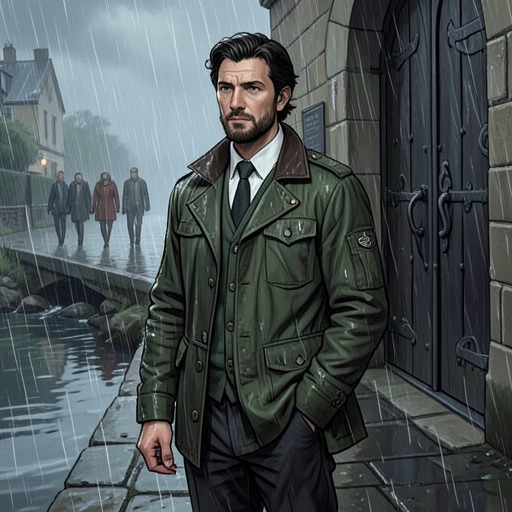
At Sligo, Donie gets off in time to arrive within the schedule’s named minute, and his walk from the station is jaunty, arms swinging. He then heads down to the Garavogue to check on the ducks. Where the river breaks before the bridge, its current can sweep a mallard fledgling away from its brood. Donie has climbed the slick stone steps carefully, crossed the divided current over rocks, and carried displaced ducklings in his hands to reunite them with their families. Two years earlier, schoolgirls applauded as he did this work. His watchfulness is practical and tender: he returns for a full half-hour, even when the river appears to be flowing well.
The routine extends to lunch and to the small decisions that make a day predictable. Donie takes plain sandwiches and orange, followed by four biscuits wrapped in foil. His mother once varied the biscuits for the sake of variety, but the uncertainty unsettled him: by shape he could often guess what he had been given, yet a round biscuit might be a Chocolate Goldgrain or a Polo. It became a dead loss, so the arrangement was specified as Chocolate Goldgrain. The detail shows how certainty, for Donie, is not an abstract preference but something secured through familiar objects and agreed repetition.
His memories of his father also turn on a bodily routine interrupted by change. His father had walked five miles each day around Lough Key forest park, among ferns and ancient oaks, over the fairy bridge and back. Then both knees failed at once, and he could walk no more. From his armchair looking out at Boyle, he described his predicament. Against that remembered loss, Donie’s own steady walking, counted steps, and careful descent to the river acquire added resonance without erasing the difference between father and son.
The Assault and Its Immediate Effects
After Donie finishes his biscuits, a man sits beside him. Donie knows he is being watched before looking up; the stare registers as heat, like nettle sting across his skin. The stranger has a thin, half-grown beard, pale eyes, and yellowish flesh. The encounter turns from an uncomfortable gaze into physical violence: the man stands over Donie on the ground, blocks out the sky, leans close, calls him a hyena, and walks away.
The insult does not remain a single remark that Donie can leave behind. As he walks through the tight streets of Sligo, his established habits begin to disappear. He does not stop at the mountaineering shop to indulge his usual dream of crampons, frost in the beard, and snowy peaks; he does not greet the wood carver or count paving slabs on the arcade shortcut. The familiar town is still there, but the actions through which Donie ordinarily inhabits it are absent.
Disruption and Narrative Significance
The effects continue when Donie reaches the station. An hour passes in trembling on the platform. He boards the twelve o’clock train but misses its departure entirely, his attention caught by the attacker’s burning eyes. He misses Collooney and the climb to Ballymote, has no joke for the inspector, and cannot resume the imaginative associations that usually accompany the route. The lost shack, which ordinarily prompts thoughts about the happy family who once lived there, instead brings back the word hyena; Boyle station does the same.
This reversal makes the assault consequential not only as an act of violence but as an interruption of Donie’s system of orientation. Exact timekeeping, repeated landmarks, familiar greetings, and attention to vulnerable ducklings have allowed his days to take a stable form. After the attack, the man’s gaze and insult intrude upon that form, displacing the sights and rituals that used to occupy Donie’s attention. The contrast between his earlier confidence in the timetable and the hour of trembling on the platform measures how far the assault has unsettled him.
Donie’s character is therefore presented through the concrete structure of his habits as much as through biography: twenty-three counted bridge steps, a speaking clock checked each morning, a journey kept for twenty years, and half an hour spent watching the river. The same attention that enables him to care for ducklings also makes the attacker’s stare difficult to set aside. In the aftermath, the repetition of the word hyena across the route marks how a single encounter has overtaken a day that once felt reliably his.